ESL logoMathematica logo
Paper suitability assessment

Is this the right demonstration paper?

A compact biomedical geometry algorithm that connects Mathematica reproduction, selective Lean proof, production C++, and Parasoft verification.
8/10 Strong candidate—with synthetic data and honest clinical limits
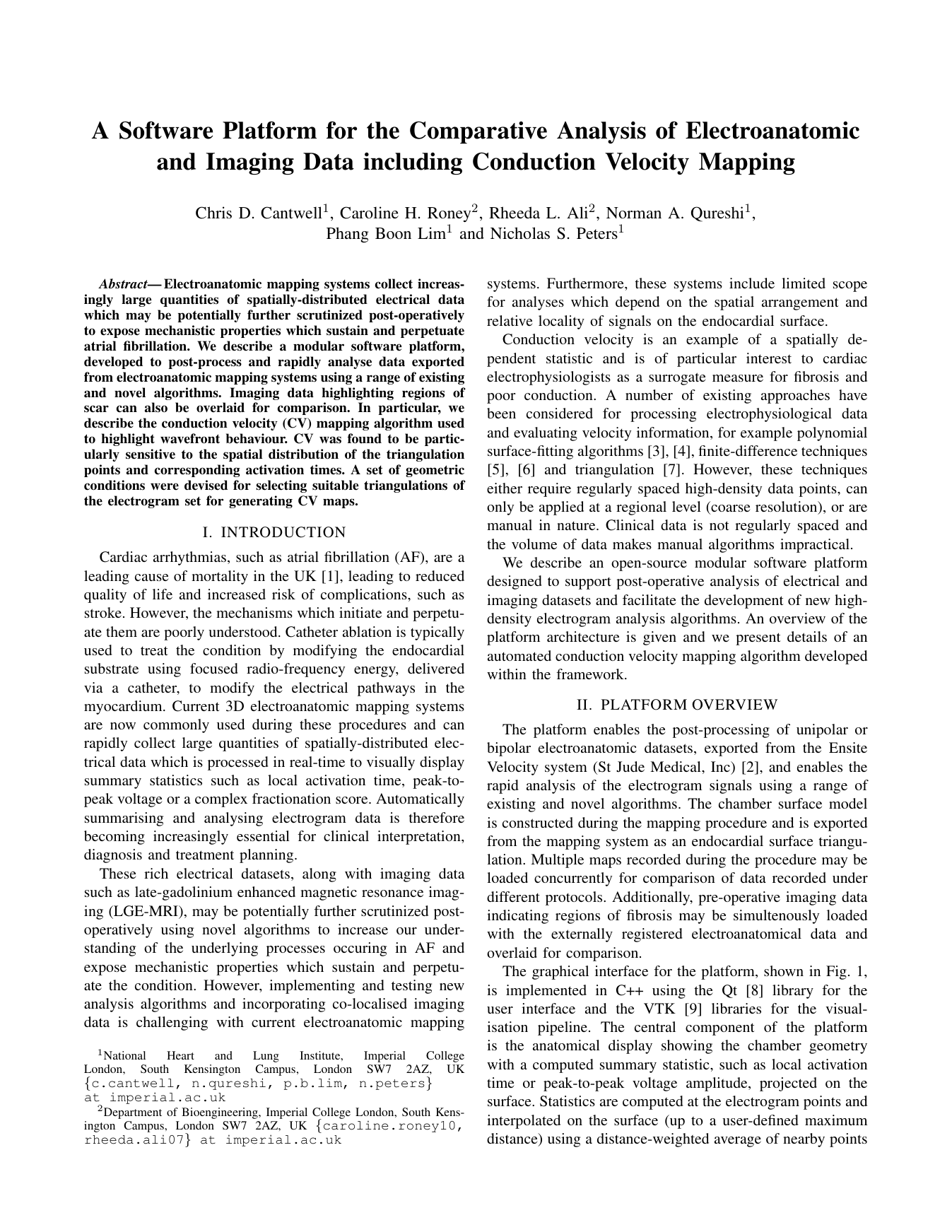
First page of the biomedical conduction velocity paper
ESL logoMathematica logo
What the paper offers

Small enough to finish—rich enough to matter

Concrete algorithm

Three-point conduction speed and direction on a 3D triangle, with explicit geometric filtering.

Biomedical relevance

Electroanatomic mapping for atrial fibrillation provides a credible safety-sensitive context.

Production connection

The original platform was implemented in C++ with Qt and VTK, making the final C++ phase natural.

coordinates + local activation times → triangle quality → speed + in-plane direction
Four pages keep the claim ledger manageable while still exposing geometry, numerical sensitivity, data limitations, and implementation risk.
ESL logoMathematica logo
Suitability scorecard

Excellent end-to-end fit—not an exact clinical reproduction

Mathematica

9/10

Ideal for geometry, synthetic wavefronts, high precision, noise sweeps, and reference exports.

Lean 4

7/10

Useful for selected geometric properties, but the paper itself is not theorem-heavy.

C++ + Parasoft

9/10

Strong numerical, boundary, robustness, static-analysis, and coverage targets.

Exact paper figures

3/10

Patient data and source are unavailable except by request.

Overall demonstration

8/10

Best presented as algorithm verification using known synthetic ground truth.

ESL logoMathematica logo
Workflow mapping

Every phase has a real job

NormalizeClaims, equations, units, domains, ambiguities
MathematicaExecutable oracle and synthetic ground truth
Lean 4Selected exact geometric guarantees
C++ / ParasoftProduction behavior, safety, tests, coverage
EvidenceTraceability and explicit limitations
The normalized specification—not the notebook—is the shared source of truth for Mathematica, Lean, and C++.
ESL logoMathematica logo
Why Mathematica fits

Build a stronger oracle than the paper provides

Known synthetic truth

  • Generate irregular electrode points.
  • Assign activation times from a wavefront with known speed and direction.
  • Recover the wavefront and quantify error.
  • Add controlled coordinate and timing noise.

Executable evidence

  • Exact and high-precision formulations.
  • Accepted/rejected triangle visualization.
  • Error versus noise and degeneracy plots.
  • Golden, boundary, and invalid vectors for C++.
synthetic truth → paper algorithm → recovered speed/direction → measured error
This validates the algorithm independently without pretending to reproduce unavailable patient-specific results.
ESL logoMathematica logo
Why Lean 4 fits

Formalize the scientific invariants—not every calculation

Useful proof targets

  • Normal is orthogonal to both triangle edges.
  • Constructed direction lies in the triangle plane.
  • Quality ratio is invariant under uniform scaling.
  • Ideal planar wavefront recovery under explicit assumptions.

Keep expectations honest

  • The paper has no formal theorem section.
  • Real-number proofs do not prove IEEE-754 execution.
  • Clinical conclusions are empirical, not Lean targets.
  • Blocked claims remain visibly blocked.
best theorem: ideal constant planar wavefront ⇒ recovered direction and speed
Lean adds independent assurance when it proves the normalized claim—not a transcription generated from Mathematica code.
ESL logoMathematica logo
Why C++ and Parasoft fit

The algorithm has exactly the right failure surface

Numerical hazards

Small time differences, small sin(theta), rounding outside the acos domain, overflow, and non-finite values.

Geometric hazards

Collinear points, near-degenerate and elongated triangles, orientation, permutation, and unit conversion.

Verification evidence

Static analysis, golden and property tests, runtime checks, branch/condition coverage, and justified suppressions.

Mathematica provides

High-precision expected values and justified tolerances.

Lean provides

Properties that become concrete C++ test obligations.

Parasoft verifies the actual implementation; Mathematica and Lean connect it back to the intended mathematics.
ESL logoMathematica logo
Blockers and interpretation risks

Two issues make the demo more credible

Unavailable clinical evidence

  • No patient electrode dataset.
  • No EnSite export samples.
  • No MRI registration data.
  • Source code is “available upon request.”

Consequence: Figures 4–6, 0.61 m/s average, and 70% overlap cannot be independently reproduced.

Formula interpretation

  • The printed tan(alpha) needs unambiguous parentheses.
  • v denotes both scalar speed and a later vector.
  • xpq − xps appears directional, not scaled to physical speed.
  • Orientation and time-sign conventions are implicit.

Consequence: derive and document the convention before coding.

These are ideal issue-ledger entries—not reasons to stop. Synthetic ground truth lets us test the corrected interpretation.
ESL logoMathematica logo
Recommended demonstration scope

Prove the kernel before rebuilding the platform

Include now

  • Figure 3 geometry and all four filters.
  • Synthetic planar wavefronts and noise.
  • Mathematica notebook, package, audit, and exports.
  • Selected Lean proofs with a pinned toolchain.
  • Standalone C++ core and CMake tests.
  • Parasoft reports and cross-language comparison.

Defer

  • Qt interface and complete VTK visualization.
  • EnSite file-format reverse engineering.
  • MRI registration.
  • Patient-specific Figures 4–6.
  • The reported 70% overlap result.
  • Any claim of clinical validation.
Smallest useful definition of done: a verified conduction-velocity mathematical kernel with traceable evidence.
ESL logoMathematica logo
Success criteria

What a convincing demo must prove

Mathematica recovers known synthetic wavefronts within defined tolerances.
Every geometric filter has boundary and invalid-input tests.
The Mathematica build and paper-specific audit pass.
Selected Lean theorems compile without proof placeholders.
C++ builds cleanly with strict warnings.
C++ and Mathematica agree across deterministic vectors.
Lean-derived properties hold in the production tests.
Parasoft findings are fixed, justified, or explicitly blocked.
Coverage satisfies the selected project policy.
Clinical claims remain marked as not independently reproduced.
The result should say exactly what is formally proved, numerically validated, implementation-verified, and unavailable.
ESL logoMathematica logo
Ready-to-paste kickoff prompt

Start with scope, evidence, and release gates

Use the wolfram-mathematica skill and relevant C/C++/Parasoft guidance to build an end-to-end verification demonstrator from C:\Amp_demos\Biosense-19-7-2026\ieee-biomed-heart.pdf. Create the project under C:\Amp_demos\Biosense-19-7-2026\heart-cv-verification. Reproduce the paper's triangle-based conduction-velocity kernel using synthetic planar wavefronts with known ground truth. Build a Mathematica package/notebook/audit and exported reference vectors; selectively prove central geometric properties in Lean 4 without sorry; implement a standalone C++ kernel; run differential, property, boundary, and robustness tests; verify with Parasoft C/C++test; and produce claim-to-evidence traceability. Do not claim reproduction of patient-specific figures or clinical findings because the source data is unavailable. Investigate the ambiguous tan(alpha) parentheses and the paper's scalar/vector use of v before coding. Use explicit domains, units, numerical tolerances, and release gates. Continue through implementation and verification rather than stopping at a plan.
Full prompt: START_PROCESS_PROMPT.md
The full prompt beside this presentation contains the exact artifacts, phase gates, Lean targets, C++ tests, and Parasoft expectations.
← Swipe to navigate →
1 / 11