
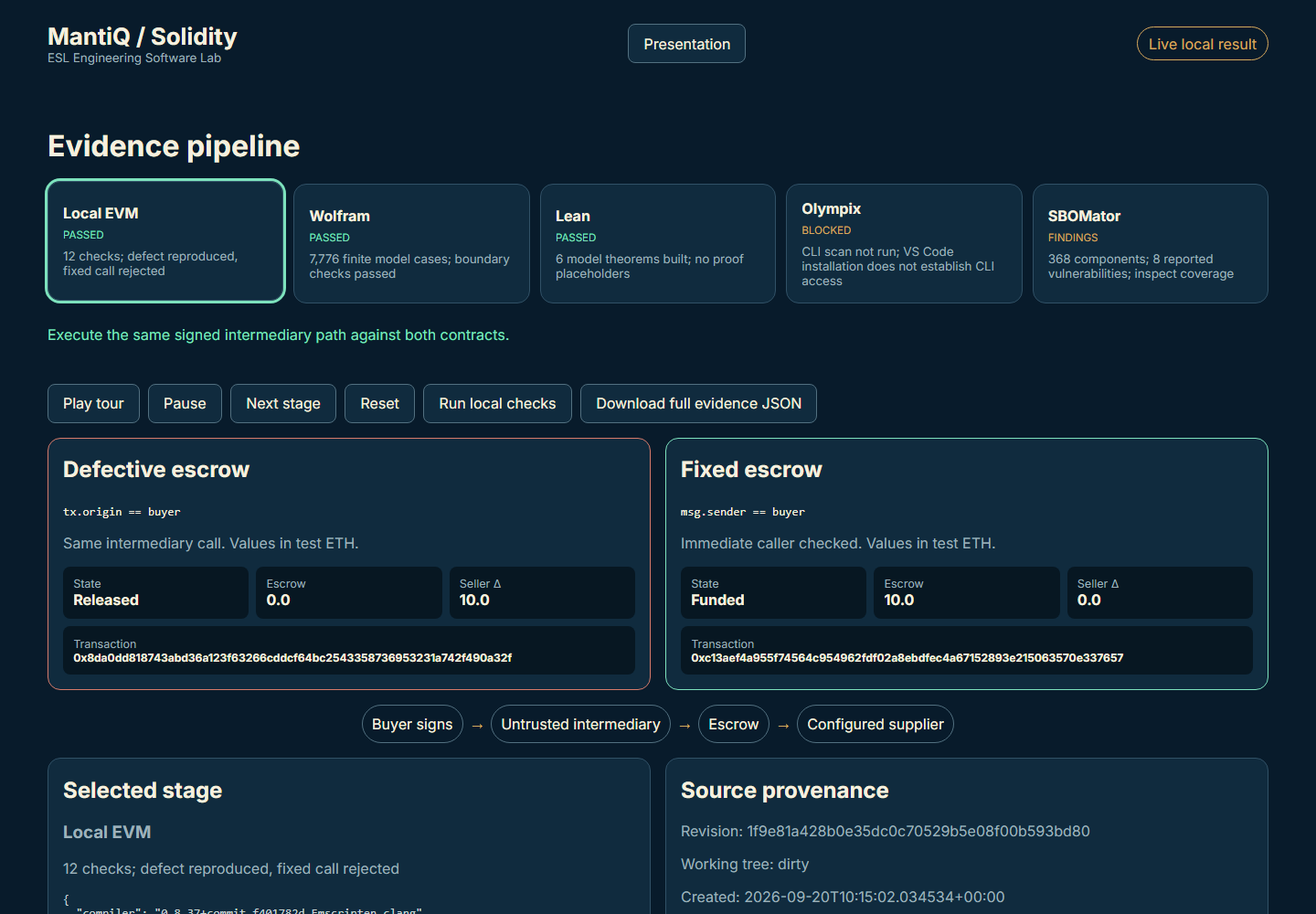
Same interaction.
Different balance.
Defective escrow0 test ETHremaining after release
Corrected escrow10 test ETHretained; call rejected
The defective escrow pays the configured supplier. The corrected escrow rejects the intermediary.
solc 0.8.37 · optimized Shanghai bytecode · Ganache in-process EVM. Deadline boundaries, exact balances, repeated settlement, and failed-transfer rollback are checked.
What happens at the exact deadline?
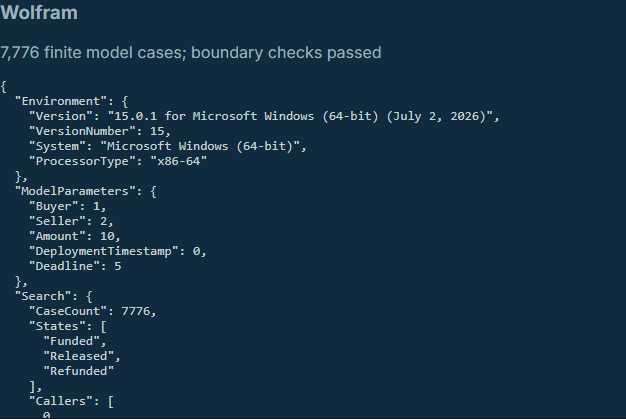
7,776 finite model cases. The boundary matters:
| Buyer call at | Release | Refund |
|---|---|---|
| deadline − 1 | Released | Funded |
| deadline | Funded | Refunded |
| deadline + 1 | Funded | Refunded |
Independent enumeration checks guard behavior, terminal states, and abstract conservation. Counterexample search finds the caller/origin mismatch.
Finite model exploration is not exhaustive EVM verification.
Six theorems.
Not a blank cheque.
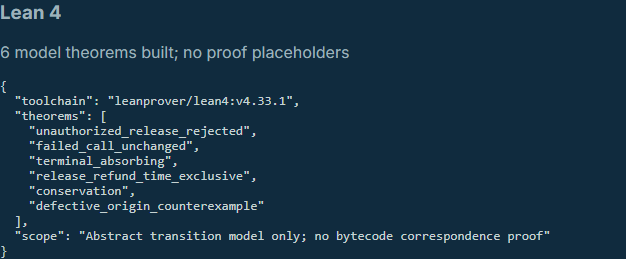
Unauthorized release rejection, unchanged rejected calls, terminal
absorption, exclusive time windows, abstract conservation, and a
concrete tx.origin counterexample.
Not proved: correspondence between the model and Solidity source or bytecode. Gas, external calls, reentrancy, and transaction ordering remain outside this model.
Lean 4.33.1 · no proof placeholders · model and assumptions included in the MIT repository.
The contract is small.
Its toolchain isn't.
ESL SBOMator builds a software bill of materials: what is inside the software. SBOMator connects that inventory to known vulnerabilities, license evidence, and engineering review.
Open this demo's actual report ↗Inventory
Generate CycloneDX component and dependency evidence, including versions, suppliers, and licenses.
Assess & explain
Correlate advisory sources; inspect dependency graphs; document vulnerability status and justifications with VEX.
Retain & monitor
Produce SBOMs, reports, and review records. Broader product workflows support rescanning, change tracking, and lifecycle evidence.
Based on ESL brochures: SBOMator CRA Compliance, Part 1, pp. 2–5; Technical Differentiators, Part 2, pp. 10–14. Product capabilities are not a claim that every feature ran in this demo. SBOMator supports evidence preparation, not certification.
77 unknowns.
77 sourced answers.
Four direct dependencies: solc, ethers, Ganache, fast-check, plus transitive development packages.
Inventory quality gate: PASSED. All 368 components now declare licenses. The 77 gaps were resolved using exact-release metadata and artifact evidence.
Explore the full HTML report ↗License enrichment only; all 8 vulnerability records remain. 77 source citations · Original report. Declared licenses are not a legal compliance verdict. No fresh CVE scan.
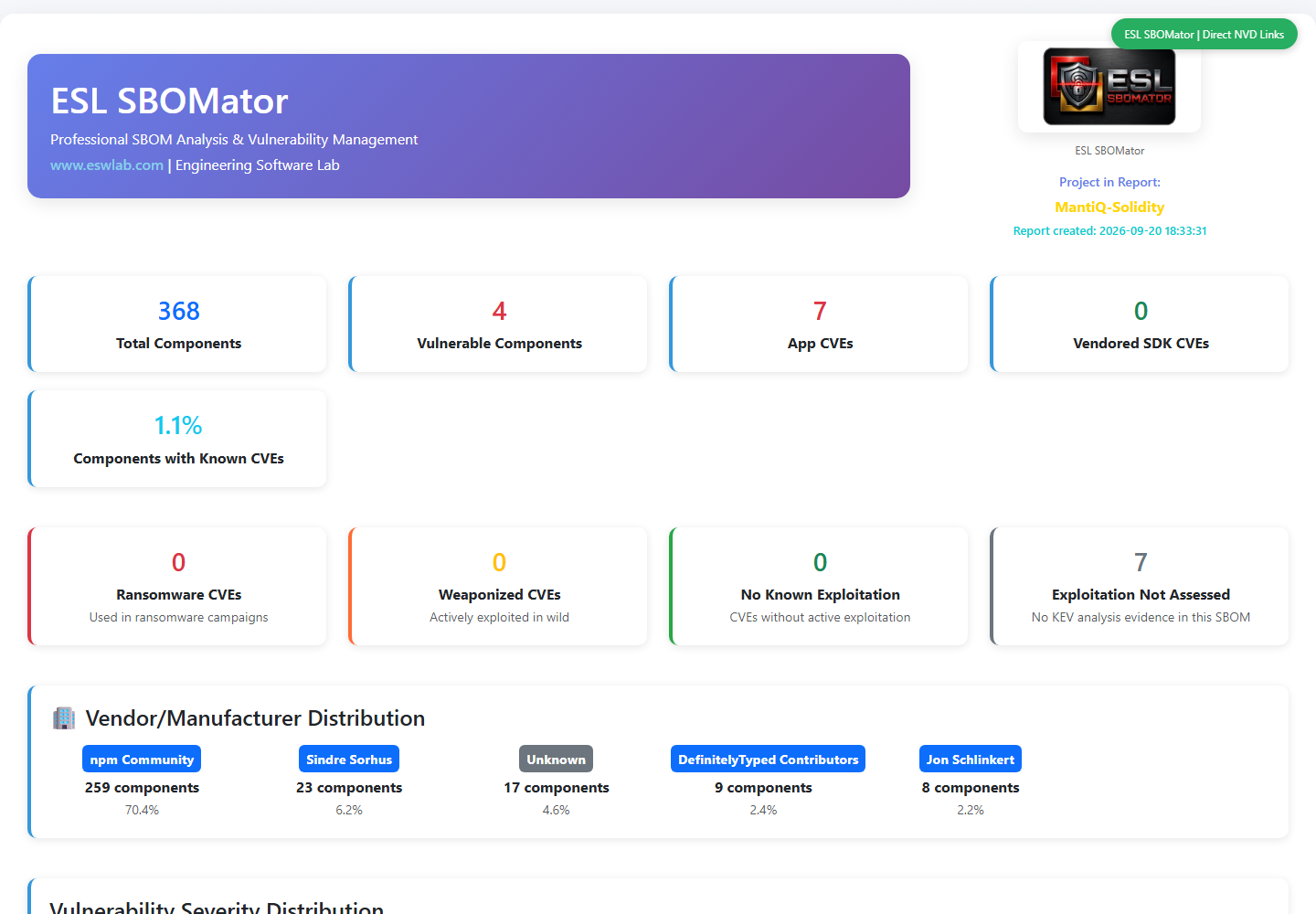
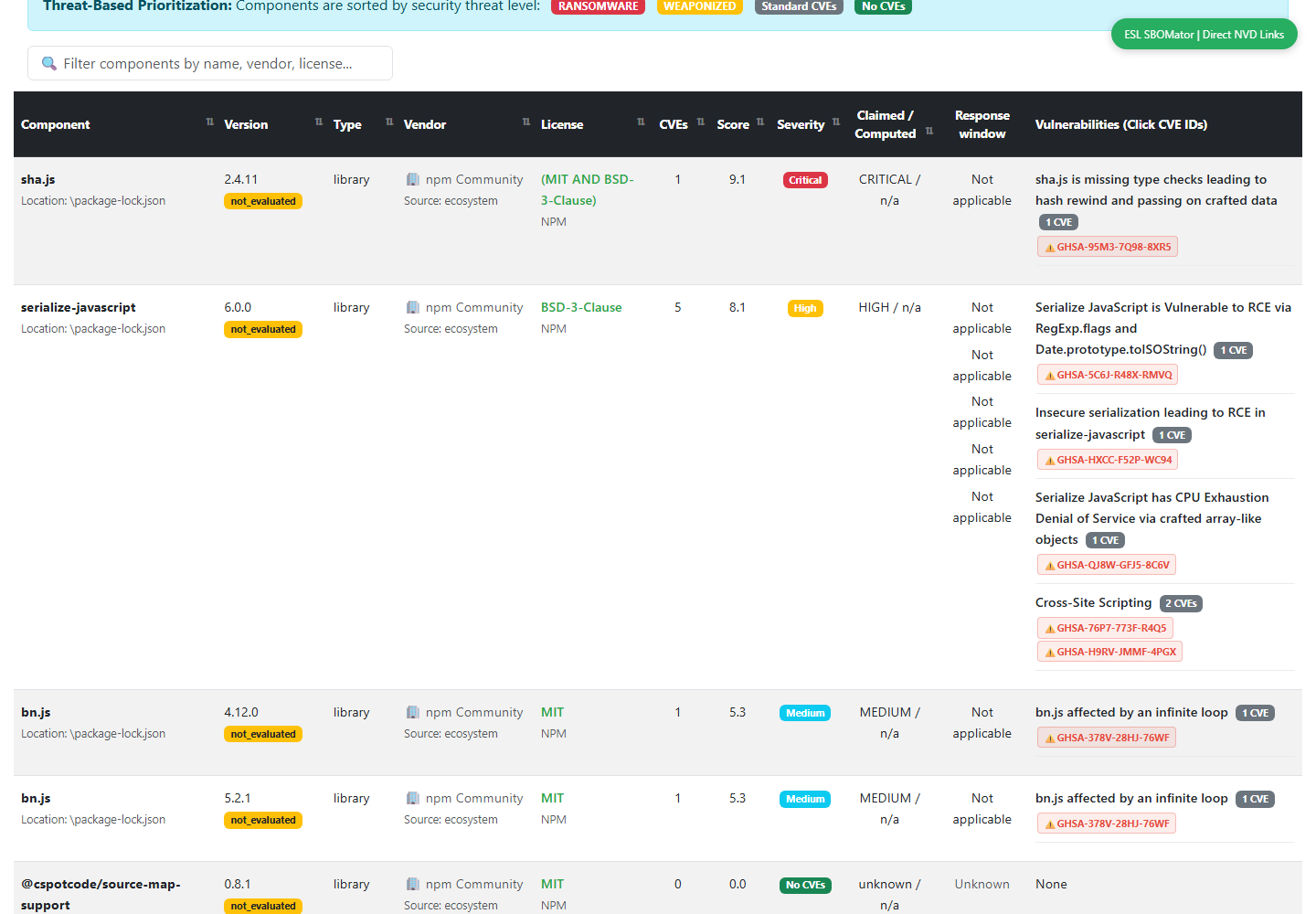
The findings didn't disappear.
| Package | Version | Records |
|---|---|---|
| sha.js | 2.4.11 | 1 |
| serialize-javascript | 6.0.0 | 5 |
| bn.js | 4.12.0 | 1 |
| bn.js | 5.2.1 | 1 |
The same advisory appears on two bn.js versions. That
explains 8 records in the dashboard versus
7 unique IDs in the report.
Package matches are not proof of exploitability in this demo. Triage reachability and update options; do not suppress a finding to make the screen green.
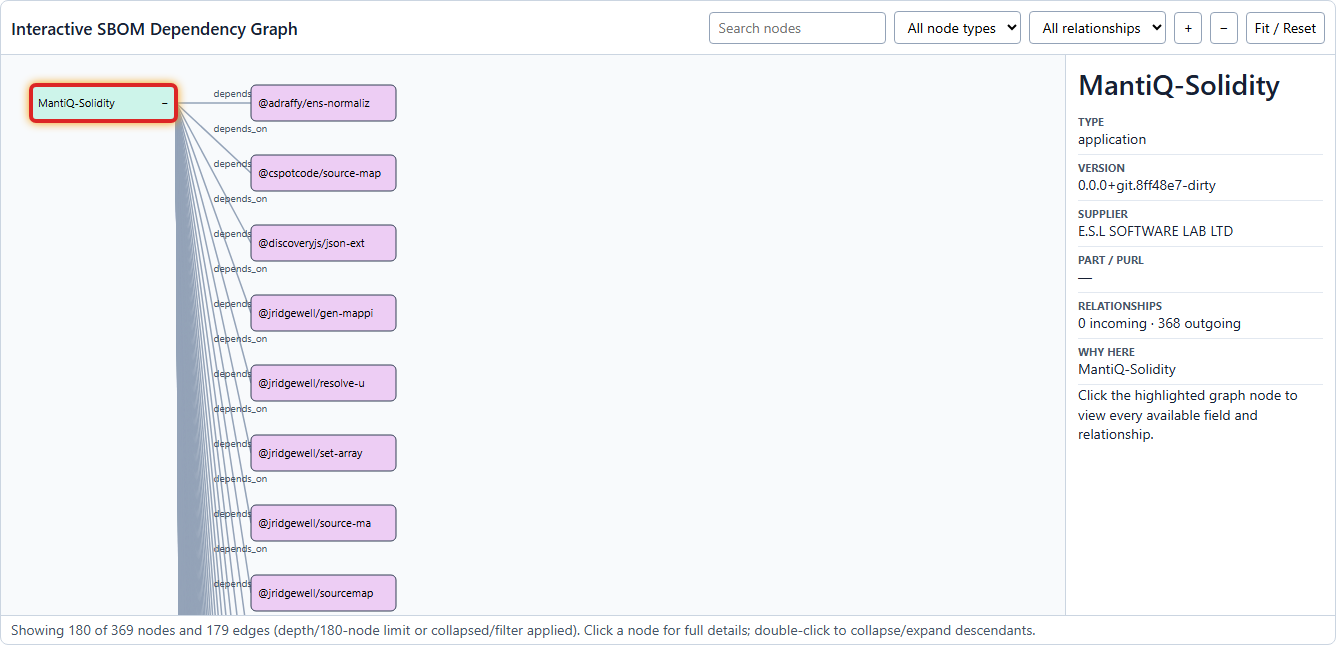
Why is that package here?
Tab to a visible package node and press Enter to inspect its evidence and relationships. Use the component-table filter for exact package lookups.
The graph makes the build and test toolchain visible alongside the escrow code.
Open the interactive graph ↗Dependency relationships do not establish function-level reachability or on-chain exploitability. This recorded graph limits its default view to 180 nodes; its search can select the project root. Use keyboard selection if clicking does not update the details panel.
Your turn.
Open the evidence.
Play the five-stage evidence tour, pause on a finding, and open the full SBOMator report.
Launch automated demo →Open SBOMator report ↗For live local execution:
python demo.py serve
Public GitHub Pages hosts recorded replay only. The loopback Python server enables real local checks.
Which assumption would you test first?
Discuss a scoped pilot around your software, dependencies, test suite, and verification goals.
daniel.l@eswlab.com
+972 9 8855803
Ha-Nagar
24 A, Hod Hasharon, Israel
A practical first conversation
What must the software do? What evidence already exists? Which unknowns matter most?
Educational demonstration, not an audit, certification, or production-readiness verdict.
Sales: sales@eswlab.com · eswlab.com