ESL – Engineering Software Lab
Embedded software consultancy · optimizing and migrating embedded projects

- Embedded software consultancy specializing in optimizing and migrating embedded projects.
- Parasoft and Perforce partner in Israel for over 20 years.
- This proof was designed and built by ESL to show a migration path with evidence, not just a plan.

ThreadX 5.6 → 6.5, Cortex-M4 → M85
One application, three migration stages, executable evidence
The same Clang-built application runs on the real ThreadX 5.6 kernel, then on current MIT ThreadX 6.5, then is built for Cortex-M85.
| Stage | Kernel / core | Evidence achieved |
|---|---|---|
| 1 TX5-M4 | ThreadX G5.6.5.2 prebuilt archive / Cortex-M4 | Built, executed: 8/8 runs |
| 2 TX6-M4 | ThreadX 6.5.2.202603 / Cortex-M4 | Built, executed: 8/8 runs |
| 3 TX6-M85 | ThreadX 6.5.2.202603 / Cortex-M85 | Compiled and linked only |
| + TX6-M55 | ThreadX 6.5.2.202603 / Cortex-M55 | Supplement, executed: 8/8 runs |
Change one thing per stage
So every difference has exactly one cause
| Step | Kernel | Core / ABI | Application source |
|---|---|---|---|
| Stage 1 → 2 | TX5.6 → TX6.5 | Cortex-M4 unchanged; soft-float → hard-float | Unchanged |
| Stage 2 → 3 | TX6.5 unchanged | Cortex-M4 → Cortex-M85 | Unchanged |
| Supplement | TX6.5 unchanged | Cortex-M55: newest core this QEMU runs | Unchanged |
- Stage 1 → 2 isolates the RTOS migration on the core the TX5 kernel was built for.
- Stage 2 → 3 isolates the CPU port change on an unchanged kernel release.
- M55 shares the Armv8.1-M port family with M85, so it is the closest runnable proxy, not a substitute for M85 execution.
The challenges of this project
What we did not have, and how each gap was closed
| Challenge | Why it matters | How ESL handled it |
|---|---|---|
| No ThreadX 5 source code: only a prebuilt binary archive | The port contract, ABI and configuration cannot be read from source or rebuilt | Recovered them from build attributes, symbols and disassembly of the 192 archive objects |
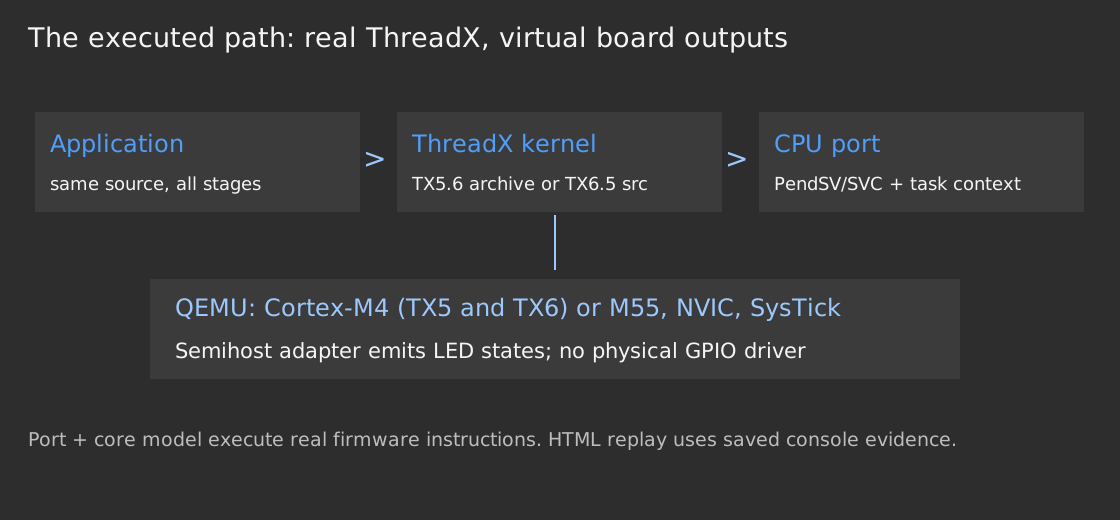
| No real target hardware: no M4 board, no M85 silicon | No physical GPIO, clocks, interrupts or cycle-accurate timing | QEMU MPS2 AN386 (M4) and MPS3 AN547 (M55), virtual LEDs and buttons, deterministic icount time |
| No Cortex-M85 emulator available | Stage 3 cannot execute anywhere in this setup | Ran the closest Armv8.1-M core (M55); M85 verified by build attributes and a full link |
| TX5 binary licence restrictions and a fixed soft-float ABI | The kernel cannot be redistributed, and every object must match its ABI | Linked from an external checkout only; Stage 1 built soft-float with packed enums; TCB size asserted |
| Compiler change from GCC to Clang | The TX5 archive was built by GCC; Clang has different defaults and assembler behaviour | Matched the archive ABI explicitly; fixed a flag-dependent startup loop found by QEMU trace |
ThreadX 5 and 6: what actually changes
Same service model; different delivery, port contract and licence
| Concern | ThreadX 5.6 (WICED archive) | ThreadX 6.5 (Eclipse) |
|---|---|---|
| Delivery | Headers + prebuilt GCC archive, no kernel source | Full C source + CPU/toolchain ports |
| Licence | Commercial; SDK copy restricted to WICED use | MIT |
| Ports in this delivery | One Cortex-M3/M4 port | M4, M55, M85 and many more |
| Float ABI | Soft-float; r4-r11 context only | Hard-float; FPU context in the port |
| Thread start / handlers | SVC; __tx_PendSVHandler, __tx_SVCallHandler | PendSV; PendSV_Handler |
| Configuration | Fixed by archive: errno extension, no error checking | Rebuilt from tx_user.h |
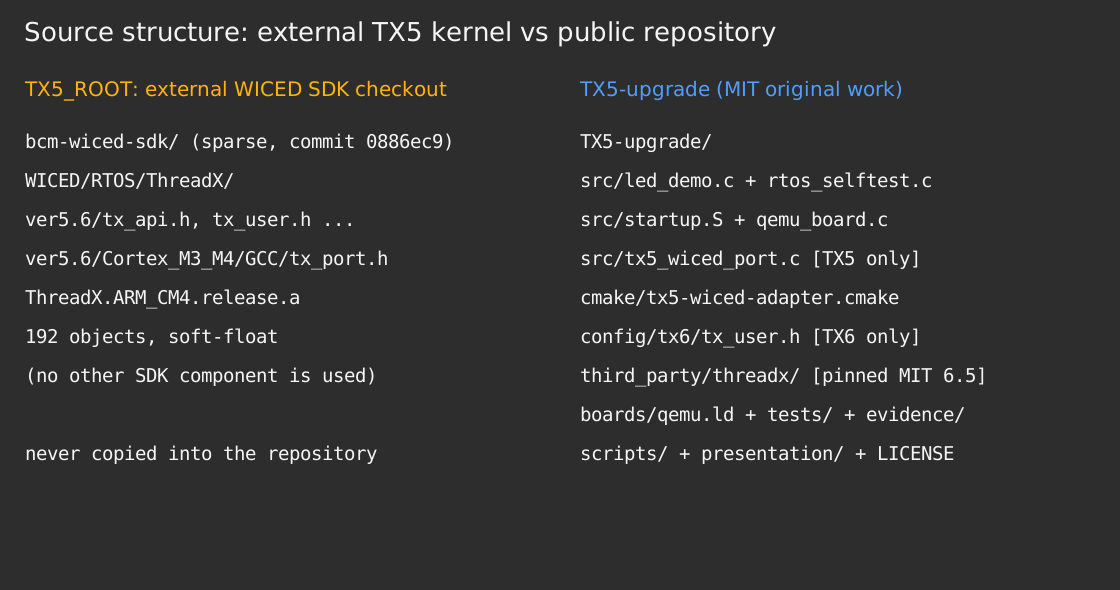
Where the ThreadX 5 kernel comes from
TX5 was never open source; the WICED SDK ships it as binaries
- The public WICED SDK 3.1.0 contains ThreadX 5.6 headers and ThreadX.ARM_CM4.release.a.
- Its README restricts those objects to WICED use, so nothing from the SDK is in this repository.
- The build links the archive from TX5_ROOT, a separate checkout; configuration fails if TX5_ROOT is inside the repository.
- CI clones the same SDK commit into the runner's temp directory for every run.
git clone --filter=blob:none --no-checkout \
    https://github.com/wwwllllllll/bcm-wiced-sdk.git $TX5_ROOT
git -C $TX5_ROOT sparse-checkout set --no-cone '/WICED/RTOS/ThreadX/'
git -C $TX5_ROOT checkout 0886ec932a063e12db768cd09428e8a8ab555bce
# ThreadX.ARM_CM4.release.a sha256:
# 71288b46e58b2c398118674b53feb708994e18740cf7e5d68bc8d070f72fac1eReading a binary-only kernel
No source, so inspect build attributes, symbols and machine code
$ llvm-readelf -A tx_thread_create.o
  CPU_name: Cortex-M4        CPU_arch: ARM v7E-M
  ABI_enum_size: Packed      (no ABI_VFP_args, no FP_arch)
$ llvm-nm tx_thread_schedule.o
  T __tx_PendSVHandler   T __tx_SVCallHandler
  U tx_low_power_enter   U _tx_thread_system_stack_ptr
$ llvm-strings tx_thread_initialize.o
ThreadX Cortex-M3/GNU Version G5.6.5.2- No VFP tag: the archive is soft-float, so every object in the image must be soft-float.
- Packed enums: GCC -fshort-enums; Clang must match it.
- The CM4 archive is the Cortex-M3 port: it never saves FPU registers.
- Unresolved WICED hooks show exactly what the board layer must provide.
The exact versions, not moving targets
Every kernel input is pinned and identifiable
| Input | Identity |
|---|---|
| TX5 kernel | ThreadX G5.6.5.2, WICED SDK 3.1.0 commit 0886ec932a06 |
| TX5 archive sha256 | 71288b46e58b2c398118674b53feb708994e18740cf7e5d68bc8d070f72fac1e |
| TX6 kernel | Eclipse ThreadX v6.5.2.202603_rel, latest observed on 2026-10-11 |
| TX6 commit | 93387b0a60382a29579bbad5045c68328e3751df |
| Compiler | clang version 22.1.3 (https://github.com/msys2/MINGW-packages b2ba9d193810f115e9af26819b666d1fa929a940) |
| Emulator | QEMU emulator version 11.1.0 (v11.1.0-12130-ge470268ff4) |
Cortex-M4, M55 and M85
Keep CPU architecture distinct from a particular microcontroller
| Property | Cortex-M4 | Cortex-M55 | Cortex-M85 |
|---|---|---|---|
| Architecture | Armv7E-M | Armv8.1-M | Armv8.1-M |
| DSP / vectors | Scalar DSP extensions | Helium / MVE | Helium / MVE |
| Floating point | Optional single precision | Configuration-dependent FP/MVE | Configuration-dependent FP/MVE |
| Security model | No Armv8-M TrustZone | Armv8-M TrustZone | TrustZone; PACBTI capability |
| This proof | TX5 and TX6 run on MPS2 AN386 | TX6 run on MPS3 AN547 | TX6 compile/link only |
The most modern runnable QEMU Cortex-M here
Probe the installed executable instead of relying on development docs
qemu-system-arm --version
qemu-system-arm -machine help
qemu-system-arm -cpu help
# installed: 11.1.0
# present: mps2-an386 / cortex-m4, mps3-an547 / cortex-m55
# absent:  mps3-an555 / cortex-m85
M55 is the newest Cortex-M CPU exposed by this installed QEMU build. QEMU development documentation mentions AN555, but it is not in the tested binary.
Licensing is an engineering input
Public on GitHub does not mean free to redistribute
- The WICED SDK README limits its ThreadX / NetX objects to use with WICED.
- The TX5 archive and headers are linked from an external checkout and never committed or published.
- The application, board layer, adapter and tests are independently written; original work is MIT.
- ThreadX 6.5 is pinned as an MIT submodule with its upstream notices.
- PDF typography embeds Roboto under OFL 1.1, with the notice shipped beside the PDF.
The source trees
The TX5 kernel stays outside; the repository holds only original work
Migration workflow
Change one dimension at a time
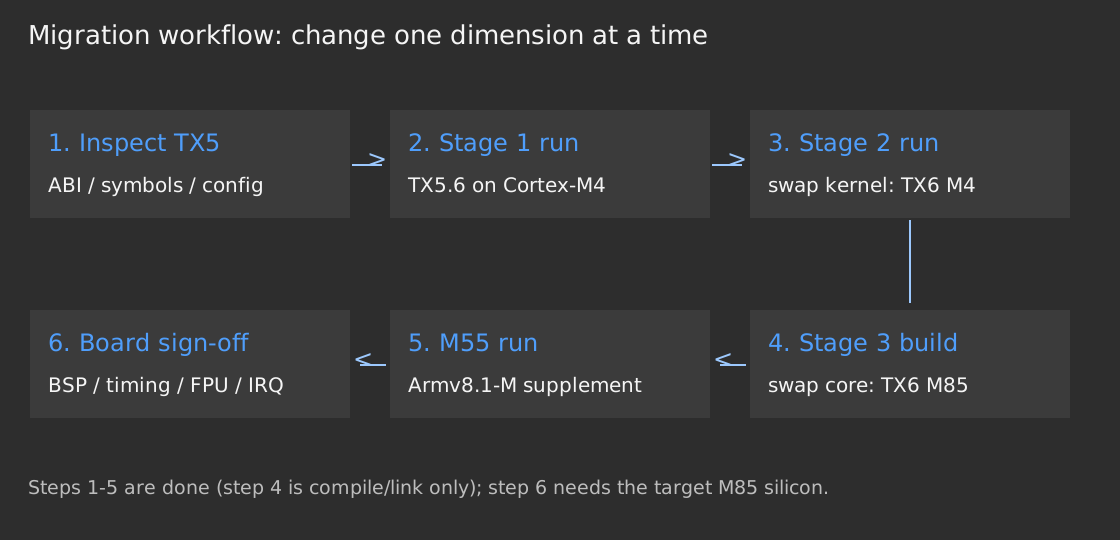
Stages 1 and 2 give a like-for-like Cortex-M4 run on each kernel. Stage 3 then needs only the CPU port change.
What really executes
No mock RTOS, no fake emulator success
Diff 1: how each kernel enters the build
Imported binary archive vs rebuilt source
# Stage 1: cmake/tx5-wiced-adapter.cmake
- add_library(threadx STATIC IMPORTED GLOBAL)
- IMPORTED_LOCATION  ${TX5_ROOT}/.../ThreadX.ARM_CM4.release.a
- INTERFACE_COMPILE_DEFINITIONS  TX_INCLUDE_USER_DEFINE_FILE
- include dirs: ver5.6/ and ver5.6/Cortex_M3_M4/GCC/
# Stages 2-3: CMakeLists.txt
+ set(THREADX_ARCH ${TX_CORE})        # cortex_m4 / m55 / m85
+ set(TX_USER_FILE config/tx6/tx_user.h)
+ add_subdirectory(third_party/threadx)
# all stages
  target_link_libraries(threadx_gpio_demo PRIVATE threadx)
With source, the kernel is recompiled for the application's ABI and configuration. With a binary, the application must adopt the archive's ABI and configuration instead.
Diff 2: the float ABI is dictated by the archive
Hard-float objects cannot link against this TX5 kernel
# cmake/clang-arm-none-eabi.cmake
- TX5: -mcpu=cortex-m4 -mthumb -mfloat-abi=soft -fshort-enums
+ TX6: -mcpu=cortex-m4 -mthumb -mfloat-abi=hard
# TX5.6 PendSV: integer context only
  mrs   r12, psp
  stmdb r12!, {r4-r11}       @ no s16-s31, no lazy FP state
  ...
mvn lr, #2 @ EXC_RETURN 0xFFFFFFFD- A hard-float task on this TX5 port would break: it saves no s16-s31 and always returns with a non-FP EXC_RETURN.
- Stage 2 is therefore also the first point where FPU code becomes safe on M4.
- The image attributes confirm it: TX5 has no FP_arch tag; TX6 M4 has VFPv4-D16 and AAPCS VFP.
Diff 3: vectors and the first context switch
TX5.6 starts threads through SVC, TX6 does not
# TX5.6 _tx_thread_schedule (from the archive)
  str   r1, [r0, #0x10]      @ SysTick CTRL |= ENABLE
  cpsie i
  svc   #0                   @ first thread starts in SVCall
# src/startup.S vector table
- .word DEMO_SVC_HANDLER     @ TX5: __tx_SVCallHandler
- .word DEMO_PENDSV_HANDLER  @ TX5: __tx_PendSVHandler
+ .word DEMO_SVC_HANDLER     @ TX6: fault_handler (unused)
+ .word DEMO_PENDSV_HANDLER @ TX6: PendSV_HandlerDiff 4: low-level init and the idle hook
Contracts recovered from disassembly, implemented in MIT code
void _tx_initialize_low_level(void) {
    _tx_initialize_unused_memory = &__first_free_ram;
#ifdef DEMO_TX5
-   _tx_thread_system_stack_ptr = (void *)demo_vectors[0];
#endif
    /* VTOR, SHPR2/3 priorities, 100 Hz SysTick: shared */
}
- unsigned long platform_power_down_hook(unsigned long ticks) {
-     __asm volatile("wfi");
-     return 0UL;        /* ticks slept; SysTick kept running */
- }- The TX5 port objects reference _tx_thread_system_stack_ptr; the TX6 Cortex-M4 port sources do not use it.
- The WICED idle loop calls tx_low_power_enter, which calls platform_power_down_hook(ticks to next timer).
- A non-zero return is added to the kernel clock (tickless mode). Returning 0 keeps normal ticking.
Diff 5: a 4-byte configuration bug
Found by the metrics, then made impossible to build
[metric] sizeof_TX_THREAD=176        <- application's view
_tx_thread_create:  movs r2, #0xb4   <- archive clears 180 B
                    bl   memset
[metric] led_stack_high_water_bytes=1024   <- impossible
# cause: -Iinclude found the TX6 tx_user.h before WICED's,
#        dropping "#define TX_THREAD_USER_EXTENSION int errno;"
+ move TX6 config to config/tx6/tx_user.h
+ _Static_assert(sizeof(TX_THREAD) == 180U, ...);
[metric] sizeof_TX_THREAD=180   led_stack_high_water_bytes=196
The kernel cleared 4 bytes past each 176-byte thread object. led_thread_stack follows led_thread in RAM, so its first fill word was zeroed and the stack scan reported a full stack. The functional test still passed: only the measurement exposed the corruption.
Diff 6: API and configuration details
Small differences that break builds or change behaviour
| Item | TX5.6 archive | TX6.5 build here |
|---|---|---|
| _tx_version_id | extern const CHAR[] | extern CHAR[] |
| Thread extension | int errno; (WICED tx_user.h) | None |
| Error checking | Disabled in release archive | Enabled (txe_ wrappers) |
| Preemption-threshold | Disabled | Enabled |
| Timer expiry | Processed in the SysTick ISR | System timer thread (default) |
| Stack checking | Off; stacks still filled with 0xEF | On |
- The application dropped its own _tx_version_id declaration and uses the port header's.
- Stack high-water is measured by scanning the 0xEF fill, which works on both kernels.
- Thread resumption is checked with an application flag, not scheduler internals.
Diff 7: milliseconds versus RTOS ticks
Keep units visible; avoid a silent tenfold delay error
#define TX_TIMER_TICKS_PER_SECOND 100   // tick rate used by both stages
#define LED_UPDATE_TICKS 25U
tx_thread_sleep(LED_UPDATE_TICKS);      // 250 ms virtual time
SysTick reload = DEMO_CLOCK_HZ / 100 - 1
SysTick_Handler -> _tx_timer_interrupt  // same symbol in TX5 and TX6
The tested board clock constants are 25 MHz for MPS2-M4 and 32 MHz for MPS3-M55. The M85 build reuses the demonstration map and clock; a real M85 SoC must replace them.
Diff 8: preserve the held-button latch
A subtle behavioural detail, checked at release as well as press
- toggle the same boolean even while the button is held
+ if (!button0) toggle0 = !toggle0;
+ output0 = button0 || toggle0;
+ qemu_led_set(0, output0);
# cycle 1: latch OFF / output OFF
# cycles 2-3: latch unchanged / held button forces ON
# cycle 4: button released / next toggle yields ONDiff 9: startup assembly under Clang
A real encountered failure, with a trace-supported fix
- sub r2, r2, r1   // Clang emitted sub.w, without updating flags
- beq copy_done    // branches on stale flags
+ copy_loop:
+     cmp r1, r2   // explicit end-pointer comparison
+     bhs copy_done
+     ldrb r3, [r0], #1
+     strb r3, [r1], #1
+     b copy_loop
QEMU traced a bus fault at 0x00080000 during the endless startup copy. The replacement uses explicit comparisons, copies .data, clears .bss and enables CP10/CP11.
Diff 10: TX6 security mode and BSP scope
Scope down the first proof; make omitted features explicit
# config/tx6/tx_user.h
+ #define TX_SINGLE_MODE_SECURE
+ #define TX_TIMER_TICKS_PER_SECOND 100
+ #define TX_ENABLE_STACK_CHECKING
# boards/qemu.ld (all stages)
  CODE 0x00000000 512 KiB, RAM 0x20000000 32 KiB
  system stack 2048 B, 8-byte aligned; VTOR = demo_vectors
PendSV/SVC priority 0xff, SysTick 0x40- Single-secure avoids exercising secure-stack paths without a non-secure image.
- Do not infer a TrustZone security policy from a successful boot.
- A real M85 SoC has its own memory map, clocks, IRQ routing, caches and MPU.
Diff 11: success is a checked contract
Fail on missing, wrong or partial output
+ require exactly one banner version, equal to the stage's
+     TX5: G5.6.5.2      TX6: 6.5.2.202603
+ verify the CPUID part number for the requested core
+ require queue / event / semaphore / mutex / pool self-test PASS
+ check all 10 button + LED rows and 9 intervals of 25 ticks
+ require explicit completion and QEMU exit status 0
+ reject timeout, wrong identity, wrong state or partial log
A TX6 image cannot pass as a TX5 run: the expected version is per stage and must match exactly. CMake also refuses a TX5 build on any core but M4, or with TX5_ROOT inside the repository.
The RTOS services really switch tasks
A higher-priority worker must preempt, suspend, resume and signal
// LED task priority 5; worker priority 4
worker: worker_progress = 1;
        tx_queue_receive(&queue, &value, TX_WAIT_FOREVER);
        worker_progress = 2;
        tx_event_flags_set(&flags, 1, TX_OR);
LED:    require(worker_progress == 1);   // preempted, then suspended
        tx_queue_send(&queue, &message, TX_NO_WAIT);
        require(worker_progress == 2);   // resumed by the send
// observed on all three runtime images:
// worker_thread_runs = 2; led_thread_runs = 12- The progress flag is application state, so the check does not depend on TCB internals.
- The timer wakes the sleeping LED task nine times through each kernel's real timer path.
- Mutex and pool checks are basic operations, not contention or fragmentation stress.
Replay the verified LED run
Recorded Stage 1 QEMU evidence, not a browser-side emulator
Two buttons are scripted active-low inputs. A held button forces its LED on; the paused toggle resumes after release. Step through cycles 0–9.
Console evidence: Stage 1, ThreadX 5.6
Cortex-M4, prebuilt WICED kernel
[boot] ThreadX GPIO behavior demo; LED output is semihosted
[core] cortex-m4
[metric] cpuid=1091551808
Copyright (c) 1996-2013 Express Logic Inc. * ThreadX Cortex-M3/GNU Version G5.6.5.2 SN: 23451-108-0501 *
[metric] sizeof_TX_THREAD=180
[metric] led_stack_reserved=1024
[metric] worker_thread_runs=2
[selftest] queue/preemption/events/semaphore/mutex/byte-pool PASS
cycle=0 BTN0=released BTN1=released LED0=ON LED1=ON tick=0
cycle=1 BTN0=released BTN1=released LED0=OFF LED1=OFF tick=25
cycle=2 BTN0=PRESSED BTN1=released LED0=ON LED1=ON tick=50
cycle=3 BTN0=PRESSED BTN1=released LED0=ON LED1=OFF tick=75
cycle=4 BTN0=released BTN1=released LED0=ON LED1=ON tick=100
cycle=5 BTN0=released BTN1=PRESSED LED0=OFF LED1=ON tick=125
cycle=6 BTN0=released BTN1=released LED0=ON LED1=OFF tick=150
cycle=7 BTN0=released BTN1=released LED0=OFF LED1=ON tick=175
cycle=8 BTN0=released BTN1=released LED0=ON LED1=OFF tick=200
cycle=9 BTN0=released BTN1=released LED0=OFF LED1=ON tick=225
[metric] led_thread_runs=12
[metric] led_stack_high_water_bytes=196
[pass] bounded LED sequence completedConsole evidence: Stage 2, ThreadX 6.5
Same Cortex-M4, same application, new kernel
[boot] ThreadX GPIO behavior demo; LED output is semihosted
[core] cortex-m4
[metric] cpuid=1091551808
(c) 2024 Microsoft Corp. (c) 2026-present Eclipse ThreadX contributors.  *  ThreadX Cortex-M4/GNU Version 6.5.2.202603 *
[metric] sizeof_TX_THREAD=180
[metric] led_stack_reserved=1024
[metric] worker_thread_runs=2
[selftest] queue/preemption/events/semaphore/mutex/byte-pool PASS
cycle=0 BTN0=released BTN1=released LED0=ON LED1=ON tick=0
cycle=1 BTN0=released BTN1=released LED0=OFF LED1=OFF tick=25
cycle=2 BTN0=PRESSED BTN1=released LED0=ON LED1=ON tick=50
cycle=3 BTN0=PRESSED BTN1=released LED0=ON LED1=OFF tick=75
cycle=4 BTN0=released BTN1=released LED0=ON LED1=ON tick=100
cycle=5 BTN0=released BTN1=PRESSED LED0=OFF LED1=ON tick=125
cycle=6 BTN0=released BTN1=released LED0=ON LED1=OFF tick=150
cycle=7 BTN0=released BTN1=released LED0=OFF LED1=ON tick=175
cycle=8 BTN0=released BTN1=released LED0=ON LED1=OFF tick=200
cycle=9 BTN0=released BTN1=released LED0=OFF LED1=ON tick=225
[metric] led_thread_runs=12
[metric] led_stack_high_water_bytes=224
[pass] bounded LED sequence completedMemory chart: linked ROM
Clang -O3; same application and service tests on every image
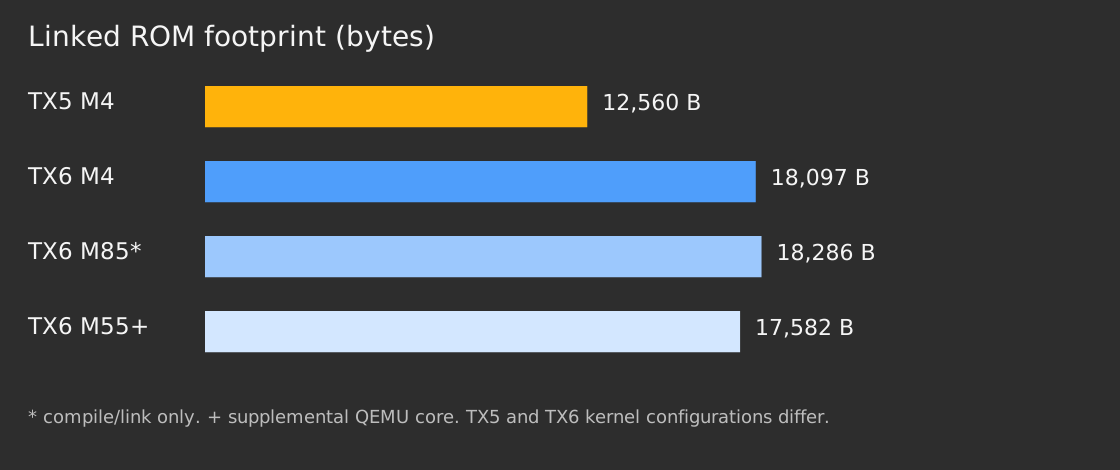
TX5 M4: 12,560 B; TX6 M4: 18,097 B (+5,537 B); TX6 M85: 18,286 B; TX6 M55: 17,582 B.
Memory chart: reserved RAM
Include stacks and test infrastructure, not only global data
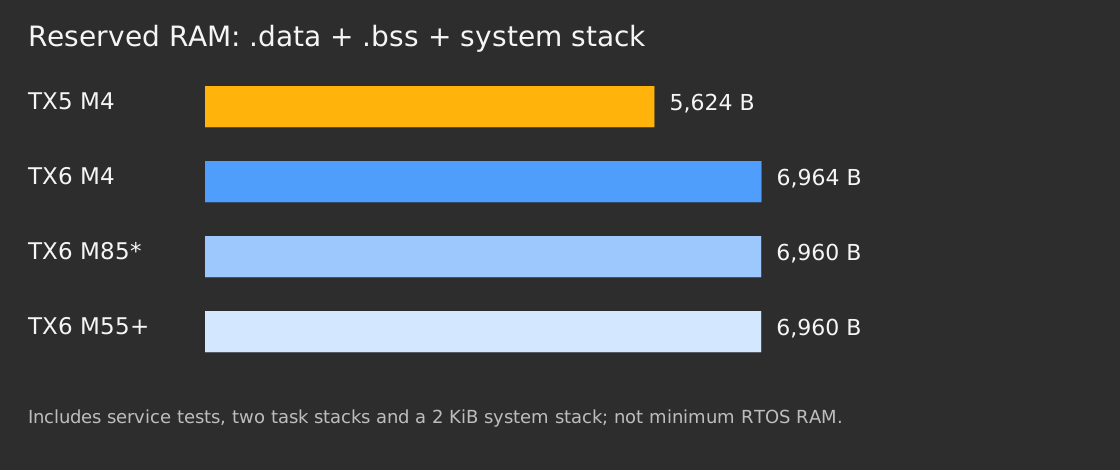
TX5 M4: 5,624 B; TX6 M4: 6,964 B. TX6 adds a system timer thread and its stack; TX5 processes timers in the ISR. sizeof(TX_THREAD) happens to be 180 bytes on both kernels with these configurations.
Stack headroom is measured, not assumed
The same fill-pattern scan on both kernels
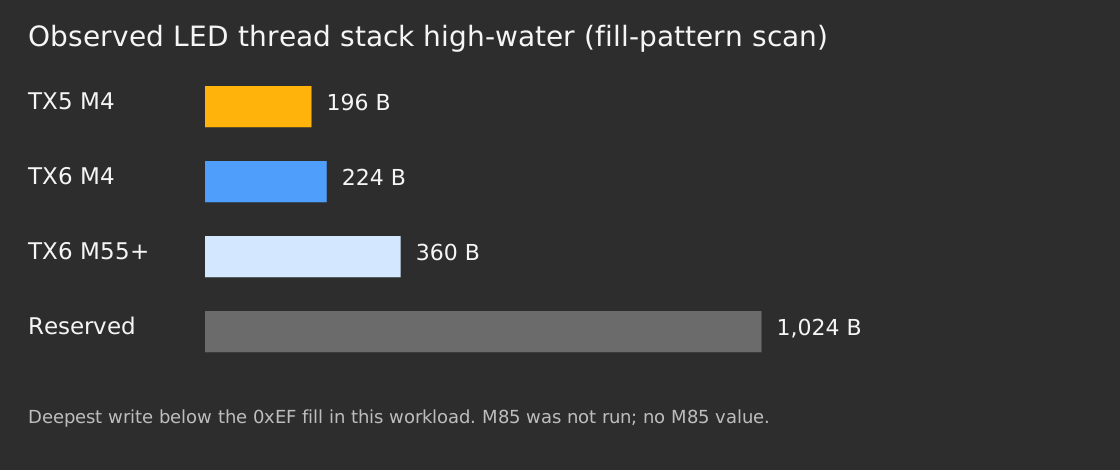
TX5 M4 196 B, TX6 M4 224 B, TX6 M55 360 B. Differences come from the ABI, compiler code generation and each port's stack frame; they are not attributed to one cause.
Performance chart: emulator test cost
Measure what was run, and say what the number means
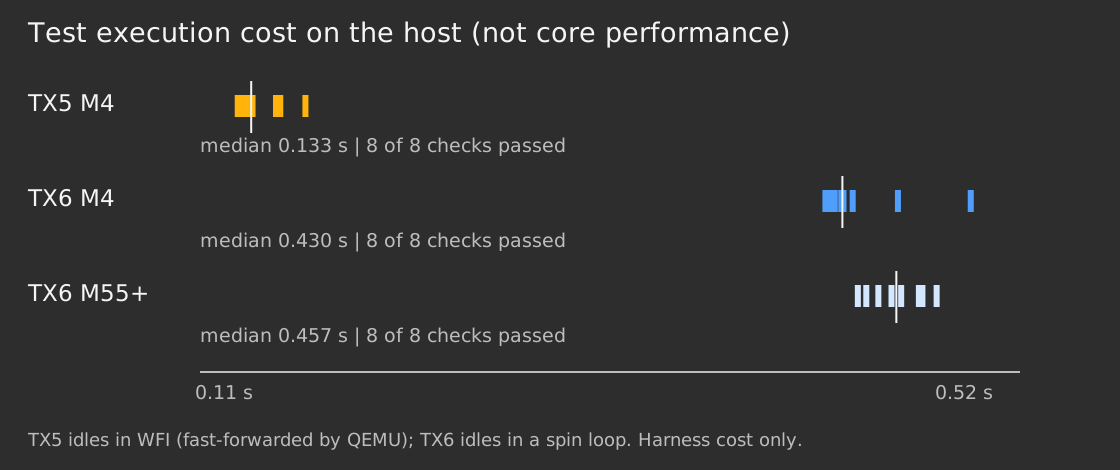
Histogram: repeatability of the host harness
Samples are retained, not reduced to an unexplained mean
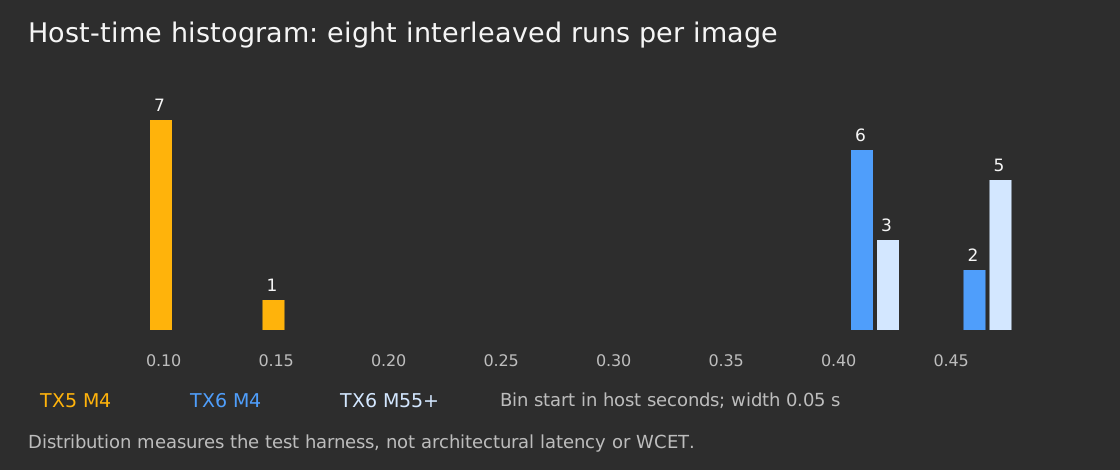
Use this to budget an automated test job and spot host variability. Do not turn the median differences into CPU or kernel performance claims.
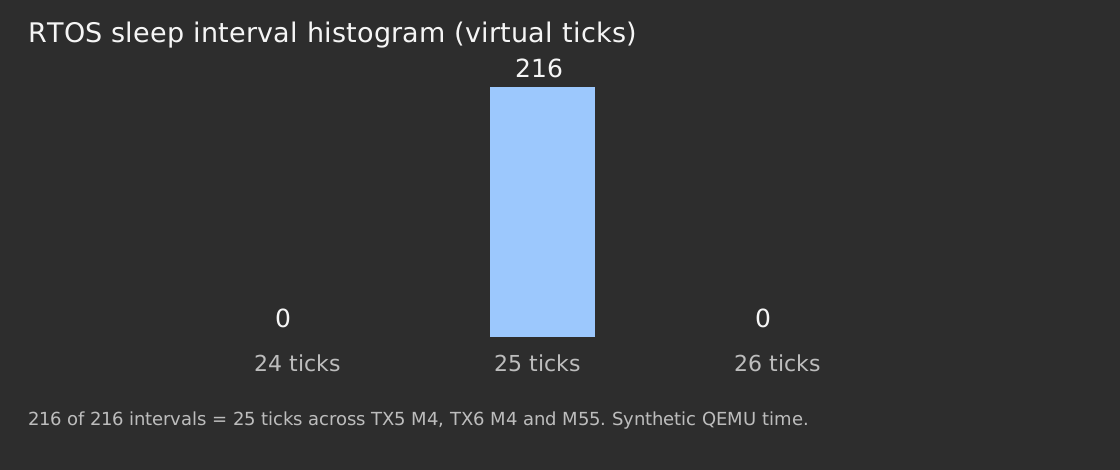
Histogram: scheduler timing contract
216 measured intervals, all at the requested 25 ticks
What the M85 build proves
Correct target attributes and resolved symbols, not execution
llvm-readelf -A build/m85/threadx_gpio_demo.elf
CPU_name: cortex-m85
CPU_arch: ARM v8.1-M Mainline
FP_arch:  ARMv8-a FP-D16      ABI_VFP_args: AAPCS VFP
MVE_arch: MVE integer and float
llvm-nm --undefined-only build/m85/threadx_gpio_demo.elf
# no undefined symbols
Clang compiled and LLD linked the unchanged application with the M85 port. The demo linker map and clock are not a production M85 SoC definition.
The hardware acceptance gate
Turn this proof into a product migration with explicit tests
| Workstream | Required evidence before production |
|---|---|
| Board / SoC | Vendor startup, linker map, GPIO polarity, clock tree, IRQ map |
| Context / ABI | Preemption + nested IRQ + mixed scalar/FPU/MVE tasks; inspect saved context |
| Security | TrustZone policy, secure gateways/stacks, MPU and optional PACBTI |
| Performance | On-silicon cycles, IRQ latency, deadline/WCET, throughput and energy, TX5 vs TX6 |
| Application | Peripheral, network, watchdog and low-power regression, incl. tickless idle |
| Governance | Licensing, SBOM, safety/change-impact assessment, traceable requirements |
Reproduce the result
Public source, pinned dependencies, raw evidence and automated checks
git clone --recurse-submodules https://github.com/zuwasi/TX5-upgrade.git
# fetch the external SDK into TX5_ROOT (see README), then:
cmake --preset tx5-m4  && cmake --build --preset tx5-m4
cmake --preset tx6-m4  && cmake --build --preset tx6-m4
cmake --preset tx6-m85 && cmake --build --preset tx6-m85
cmake --preset m55     && cmake --build --preset m55
ctest --test-dir build/tx5-m4 ; ctest --test-dir build/m4
ctest --test-dir build/m55
python -m unittest discover -s tests -p test_verifier.py -v
python scripts/collect_evidence.py --repeats 8
GitHub CI runs all four images, including Stage 1 against a fresh SDK clone. CI uses Linux packaged tools, so versions may differ from the recorded Windows run.
The technical conclusion
A bounded yes, backed by executable evidence
- YES: the application runs unchanged on the real ThreadX 5.6 Cortex-M4 kernel and on ThreadX 6.5.
- YES: behaviour, service checks and every tick match between TX5 and TX6 on the same core.
- YES: the same application compiles and links with the upstream Cortex-M85 port.
- LEARNED: with a binary kernel, its ABI and header configuration are part of the contract.
- NOT YET: M85 runtime and real-board BSP / timing / security qualification.
Public source: github.com/zuwasi/TX5-upgrade
Presentation: zuwasi.github.io/Public-html-pages/tx5-upgrade/
Sources and evidence trail
Primary references and local measured artifacts
- WICED SDK 3.1.0 (external TX5 kernel source)
- WICED GPIO behaviour reference
- Originally linked ThreadX release
- Selected release
- ThreadX release history
- Current MIT license
- Arm Cortex-M85
- Arm M-profile architecture
- Arm Helium
- QEMU MPS2/MPS3 development docs
- Raw measurements
- Stage 1 TX5 M4 console
- Stage 2 TX6 M4 console
- Supplement M55 console
Planning an embedded migration?
Talk to ESL about optimizing or migrating your embedded project
Embedded software consultancy specializing in optimizing and migrating embedded projects. Parasoft and Perforce partner in Israel for over 20 years.