Daniel Liezrowice · ESL Engineering Services

Complex engineering,
made verifiable.

I help engineering teams turn complex C/C++, embedded, AI, and research challenges into verified, auditable deliverables. Services include C/C++ debugging and modernization, MISRA and safety compliance, SBOM and supply-chain security, AI-tool assessment, Wolfram and Lean formal verification, and embedded Linux or accelerator prototyping.

Portfolio: https://zuwasi.github.io/Public-html-pages/

~250public and private repositories
120+public repositories and community resources
6ESL AI LogicLab applications
8featured engineering service areas
Services with supporting work

Working evidence, not a capability list.

Each service below links to a public presentation, demonstration, analysis, or implementation that shows how I approach the work. These examples are a fraction of a larger portfolio, much of which consists of confidential, bespoke customer projects.

SERVICE 01

C/C++ debugging and defect investigation

Reproduce difficult failures, separate symptoms from causes, collect GDB and sanitizer evidence, correct ownership and lifetime defects, and preserve the result with regression tests.

View the C++ debugging evidence lab →
SERVICE 02

MISRA C compliance and remediation

Analyze safety-critical code, triage violations, implement controlled fixes, document formal deviations, and verify changes through unit tests and compliance reports.

View the MISRA C:2023 remediation case →
SERVICE 03

Embedded Linux and Yocto BSP engineering

Design guided BSP workflows covering component selection, isolated builds, simulation, testing, CVE triage, SBOM, VEX, and evidence-based release gates.

View the Yocto BSP Studio concept →
SERVICE 04

SBOM, CVE, and supply-chain security

Generate and assess SBOMs, investigate dependency exposure, triage CVEs and malware risk, map licenses, and produce audit-ready evidence for connected or air-gapped environments.

View real-time supply-chain detection →
SERVICE 05

AI coding-tool security and CISO assessments

Evaluate AI development tools for enterprise adoption, data handling, access boundaries, supply-chain exposure, governance, and regulated-environment readiness.

View the CISO assessment →
SERVICE 06

Formal verification with Wolfram and Lean 4

Translate research claims into executable models, cross-check numerical behavior, derive invariants, and create kernel-checked proofs for critical properties.

View certified numerical verification →
SERVICE 07

Research-to-hardware prototyping

Move from papers and mathematical models to reproducible computation, formal properties, HDL simulation, FPGA-oriented prototypes, and an explicit physical-validation plan.

View the FHE accelerator workflow →
SERVICE 08

CUDA and edge-AI platform migration

Assess CUDA inference pipelines, export compatible models, map preprocessing and operators, build target configurations, and validate performance on edge-AI platforms.

View the CUDA-to-Axelera guide →
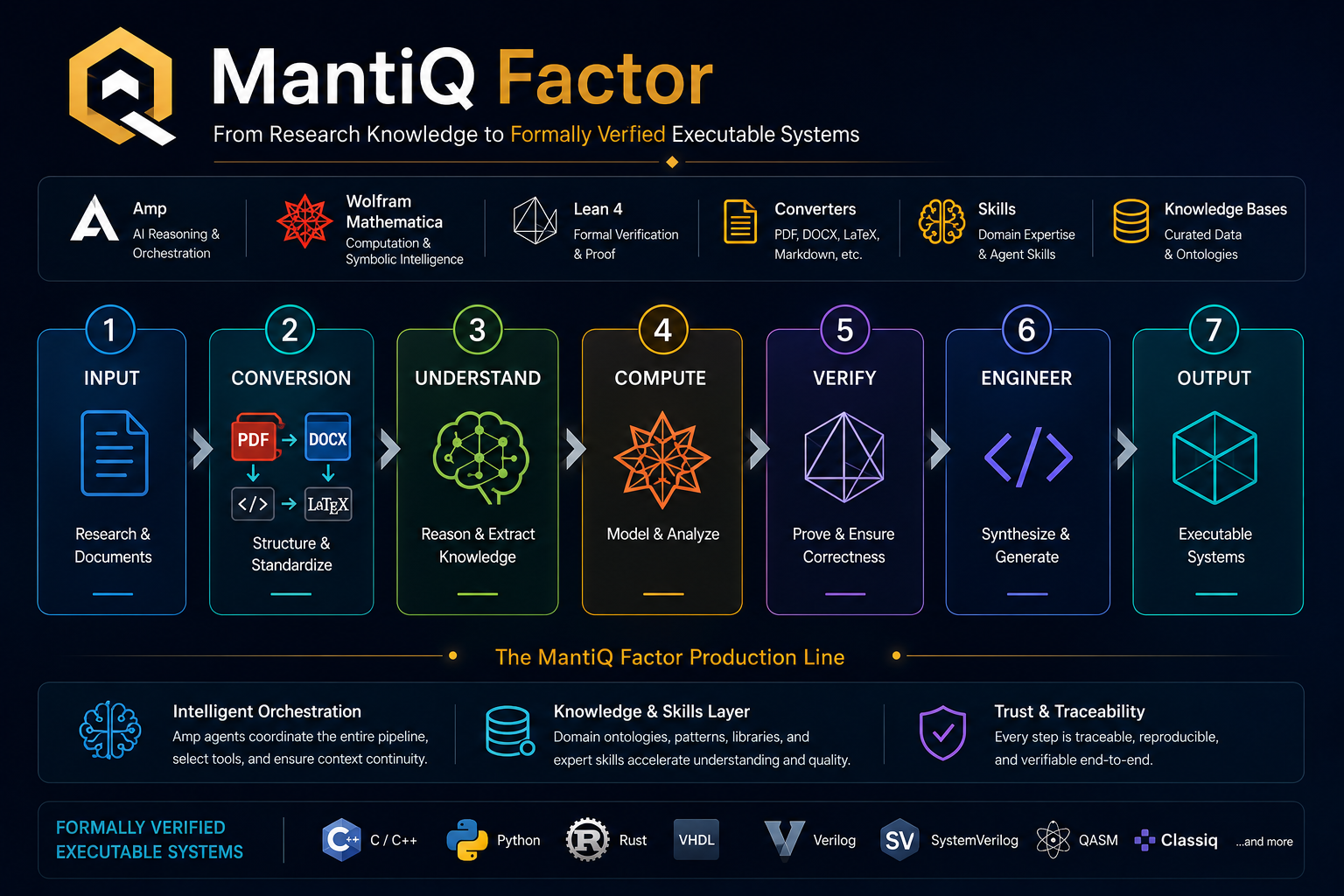
MantiQ Factor production line from research documents through computation and formal verification to executable systems
Creator of the MantiQ Factor product
Research knowledge to verified systems

The MantiQ Factor

MantiQ Factor is my product vision and engineering workflow for converting research and technical documents into traceable, formally verified executable systems. It combines structured document conversion, AI orchestration, Wolfram computation, Lean 4 proof, domain skills, curated knowledge, and code or hardware synthesis.

The goal is not automatic code generation without controls. Every stage is designed to remain inspectable, reproducible, and connected to its source evidence.

ESL AI LogicLab Apps

Products built for secure engineering workflows.

ESL AI LogicLab develops local and air-gap-capable applications for environments where code privacy, correctness, traceability, and auditability matter.

Assemblomator

Multi-architecture static analysis for assembly language, with rule-based inspection, reviewed AI fix suggestions, and regulatory reporting.

Explore Assemblomator →

FixCreator

An isolated local-LLM workflow for precise, reviewable fixes to C, C++, and C# static-analysis findings without sending source code to the cloud.

Explore FixCreator →

PythonStator

A coordinated Python analysis workflow combining seven engines with deduplication, unified severity, source context, GUI review, and repeatable CLI execution.

Explore PythonStator →

ReactStator

Local React analysis for component health, dependency risk, dead code, modernization planning, security review, and QA quality gates.

Explore ReactStator →

SBOMator

Air-gap-ready SBOM, vulnerability, malware, license, AI/ML inventory, and dataset-provenance analysis for regulated software supply chains.

Explore SBOMator →

TSscrutinizer

TypeScript-native, air-gapped SAST that correlates multiple scanners, assesses reachability locally, and keeps every proposed fix under human review.

Explore TSscrutinizer →
Portfolio and community contribution

Private client delivery. Public engineering contribution.

My work spans approximately 250 public and private repositories. More than 120 are publicly visible; most private repositories contain bespoke customer work that cannot be published because it was created for specific organizations and environments.

Public project portfolio

The public portfolio connects presentations, demonstrations, technical analyses, reports, prototypes, and reproducible engineering workflows across embedded development, AI, security, formal methods, and scientific computing.

A continuing donation to open source

I publish reusable demos, educational labs, technical guides, security research, verification workflows, and working source code as a practical donation of engineering time and knowledge to the open-source community.

These public artifacts are intended to help other engineers learn, reproduce results, challenge assumptions, and build safer systems. They are also transparent evidence of the services I can deliver.

Start with the engineering problem

Need a result that can survive technical review?

Bring the defect, research paper, compliance target, legacy codebase, supply-chain question, or prototype objective. We will define the evidence required and build the smallest credible path to a verified deliverable.